My journey into my family's story started, as you'd expect, with my name—Collins. My father dropped only sparse hints about Ireland, but my brother once shared a tale he'd heard that our great-grandfather was a cousin of the great Irish rebel Michael Collins.
That didn't quite add up, since Michael Collins was famously from Cork, while my father claimed Wexford roots. But it soon became apparent that his father's lineage originated in Cork. It was his mother's Doyle lineage that was from Wexford.
I still haven't found any familial link to the great Michael Collins, and I am sure almost all people with a Collins of Cork ancestor will claim kinship. Anyway, it's impressed my son's landlord, who announced Michael Collins was his hero and now declares my son as his best tenant ever!
Like my grandmother Lily Doyle, I never met my grandfather, John Joseph Collins, or Jack as he was known to his family. Jack died before I was born. My father never mentioned their names or really spoke of them. I think I believed my grandfather was born in Ireland; I'm not even sure of that. So this has been a journey for me too.
Of my four family lines, the Collins are the ones who stayed put. The Doyles found their way onto the railways, the Guards into the Hafod chapels, the Miners into a trade. The Collins arrived in Greenhill, settled into labouring around the copper works, and stayed there — four generations in the same square mile. They didn't leave wills. They didn't get their portraits in the local paper. But they kept the family together through poverty, illness, and the workhouse, and the line carried on.
The record they left behind is thinner as a result — census entries, parish registers, a court report or two, a cross instead of a signature on a marriage certificate. This is their story told from those.
Jeremiah Collins – A life unknown
My story of the Collins family begins with Jeremiah Collins, my third great grandfather, born, I believe, in 1805 in the West of Cork around Castle Townsend. Jeremiah and his wife, Ellen Minihane, married in 1823 and had seven children.
Records are sparse due to the wholesale destruction of census records during the period of most of Jeremiah's life. It didn't help that parish records in Castle Townsend were not recorded until 1834. However, we can locate Jeremiah in Castle Townsend at 5 Main Street in 1850, thanks to the Griffith's Valuation survey work carried out across Ireland.
Here, Jeremiah is recorded as an occupier on Main Street in Castle Townsend of a small house and garden, leased from Eliza Collins, with the property valued at £1 0s 0d.
The 1850 Griffith's Valuation record for Jeremiah Collins was made at a moment of profound hardship in Ireland. West Cork, where Castle Townsend is located, was among the regions most severely affected by the Great Famine of 1845 to 1852, which claimed approximately one million lives and drove a further million to emigrate. That Jeremiah Collins appears in the record at all tells us he was among those who survived and remained.
I cannot find any further records for Jeremiah: his occupation, whether he stayed in that area or when he died. All have proved impossible to find thus far. But never say never, and maybe one day I will be able to expand on Jeremiah's story and understand more about the man himself.
Cornelius Collins – The journey from Cork to Swansea
In 1831, Jeremiah and Ellen had my second great-grandfather, Cornelius, the first of my Collins lineage to make the journey from Cork to Swansea. He settled in Greenhill, like many of the Irish before him who had taken the same journey. Here he lived most of his life.
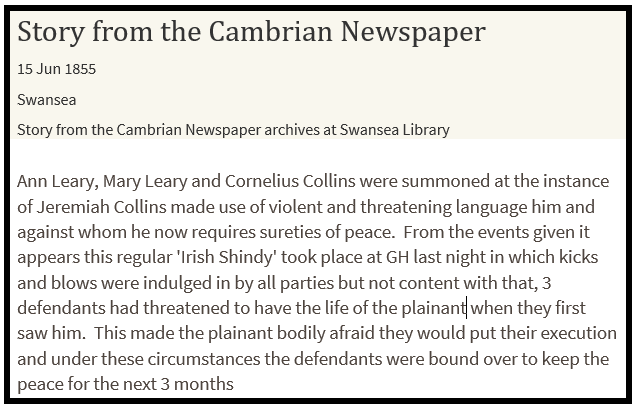
It's hard to say with any certainty when Cornelius made his journey. The records suggest from at least 1855 when a newspaper article about an "Irish Shindy" in Greenhill ended up as a violent brawl between a Cornelius Collins, Jeremiah Collins, Mary Leary and Ann Leary. This information matches with his subsequent marriage to Mary Leary who had a sister Ann. Maybe Jeremiah was visiting? I'm not sure he'd want to come again!
Mary Leary was from Bandon, also in County Cork, and appears to have travelled from Cork to Swansea with her family sometime between 1837 and 1839. Her mother was widowed by the 1841 Census and described as a pauper. Ann was her sister born in Swansea. Mary was Cornelius' lifelong partner.
Cornelius' and Mary's life was marked by poverty, overcrowded housing, moving from home to home around the Greenhill area, and skirmishes with the law around drinking, fighting and petty crime.
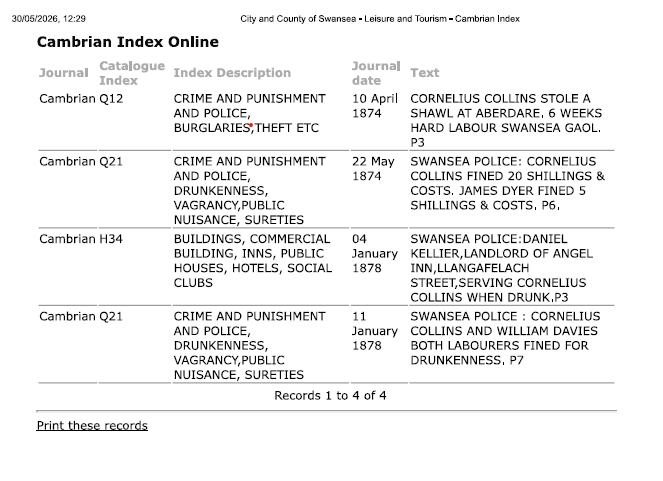
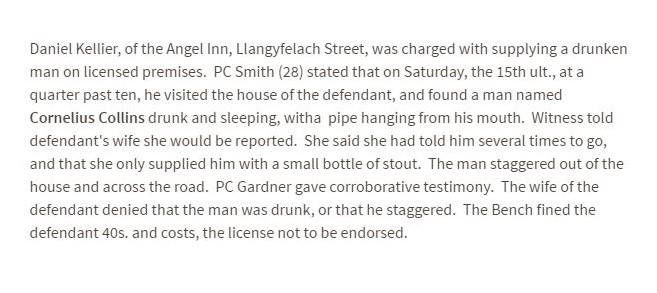
Cornelius and Mary had six children together, several before they were married. In the context of 19th and early 20th-century Greenhill, Swansea, being unmarried and having children out of wedlock was highly stigmatised by the Catholic Church and society. However, it was far from uncommon and a recognised reality in this impoverished, overcrowded industrial area, with illegitimacy patterns reflecting the broader socio-economic realities of South Wales.
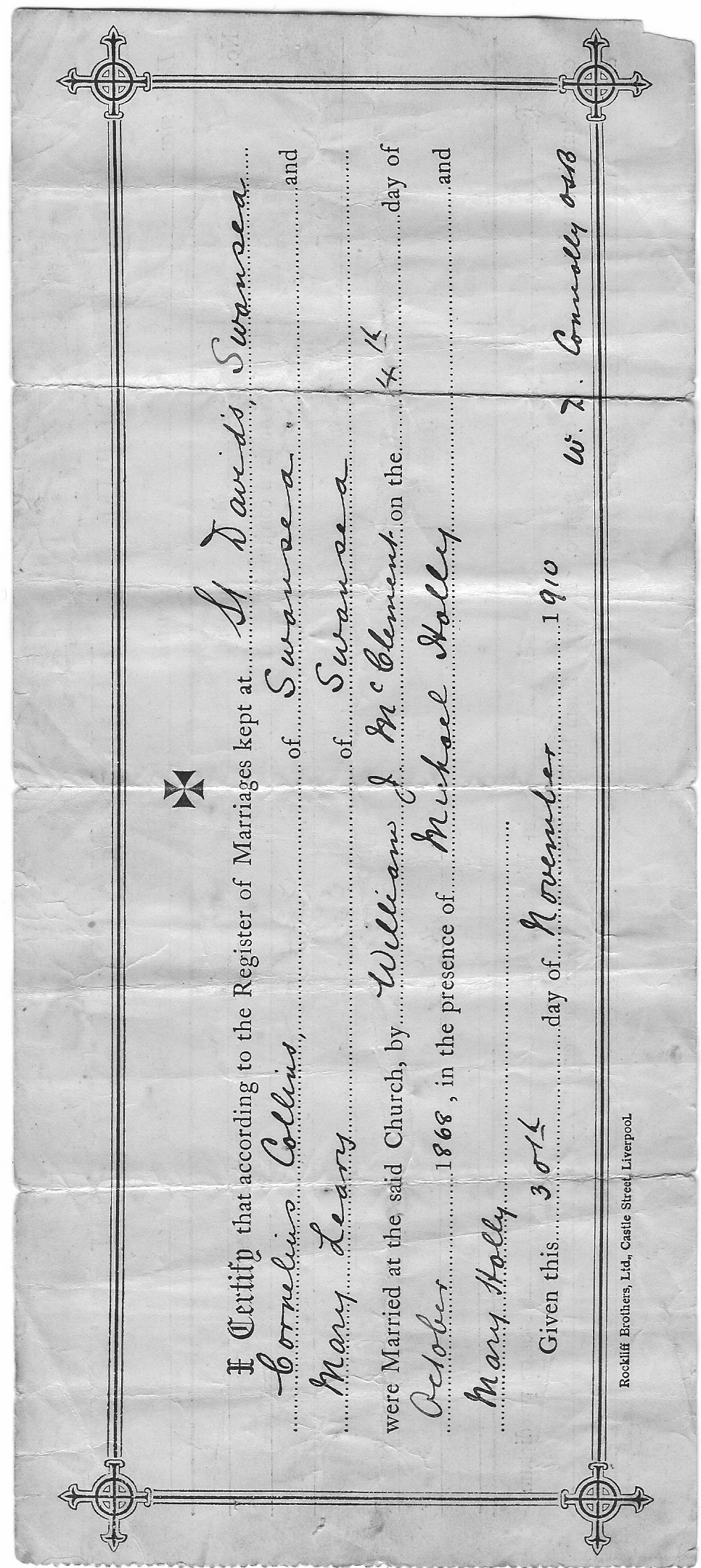
On 4th October 1868, Cornelius and Mary married at St David's Church. They made a cross for their signatures, indicating they were both unable to read and write.
Prior to their marriage, they appear to have moved around quite a lot in and around Greenhill. They settled into Convent Street in Greenhill from 1890. Their family of 8 would have had little space and privacy. Convent Street in those days featured overcrowded housing for the working classes. Census data from this era reveals severe overcrowding, with two-room cottages sometimes housing up to 12 people.
In 1901, he was no longer head of household and his daughter, Elizabeth, her husband and children, were the main occupiers, with Cornelius and Mary marked at the bottom as mother-in-law and father-in-law.
According to the censuses, he worked as a general labourer until at least the 1901 Census, at the age of 69.
They both simply fade from the official records after 1901 — too old for steady work, probably moving between family members or cheap lodgings. The next record of Mary is when she died in 1905, and Cornelius ended up in the Swansea Union Workhouse at Mount Pleasant in 1912 until he died in 1913. They were buried together in Danygraig Cemetery in Port Tennant.
Theirs was a hard life by anyone's reckoning — poverty, overcrowded rooms, the workhouse at the end — but they had built a family in Swansea that outlasted them, and it is through that family that their story carries on.
The first Welsh born Collins
Into this world of hard graft, poverty, slum housing and petty crime was born their son, John Collins, my great grandfather. He was born in October 1863 wherever Cornelius had managed to find somewhere for his family to live. Mostly seen in records as John Collins, but sometimes John A and on electoral rolls as John Andrew. Was he named after Cornelius' sibling, Andrew from his days back in Cork? I'd like to think so.
He first pops up on the 1871 census as a seven-year-old scholar. Unlike his mother and father he was educated to a point at least despite the challenges of where he lived. His marriage certificate shows he could certainly write his own name.
At the next census at 17 he was a general labourer still living with his parents and siblings, now in Marsden Street. Within five years he had become a furnaceman and had married Eliza Beck. They married on 16 October 1886 at St Joseph's Roman Catholic Church, Swansea. Eliza's father also made the journey to Swansea from Bath and sought work in the gas works on Oystermouth Road.
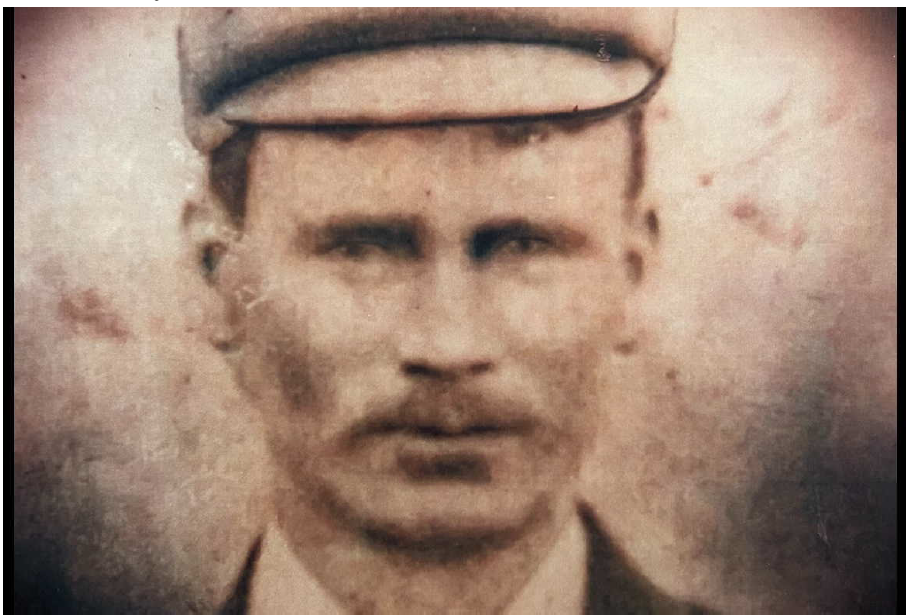
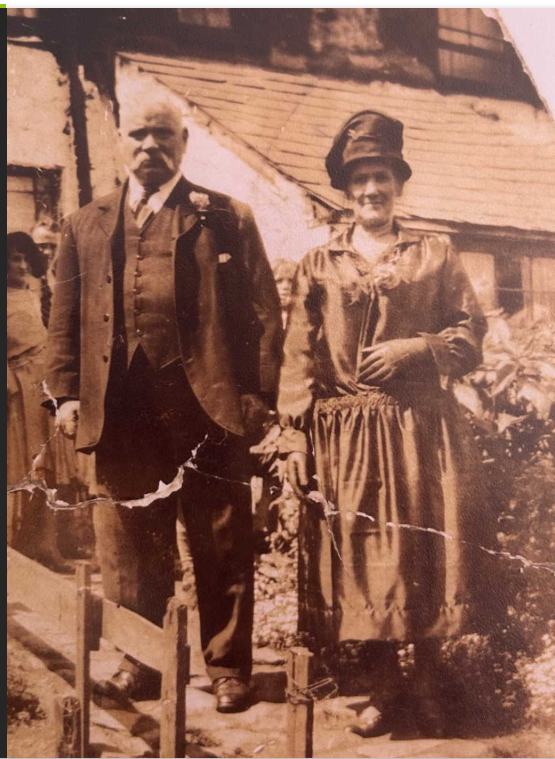
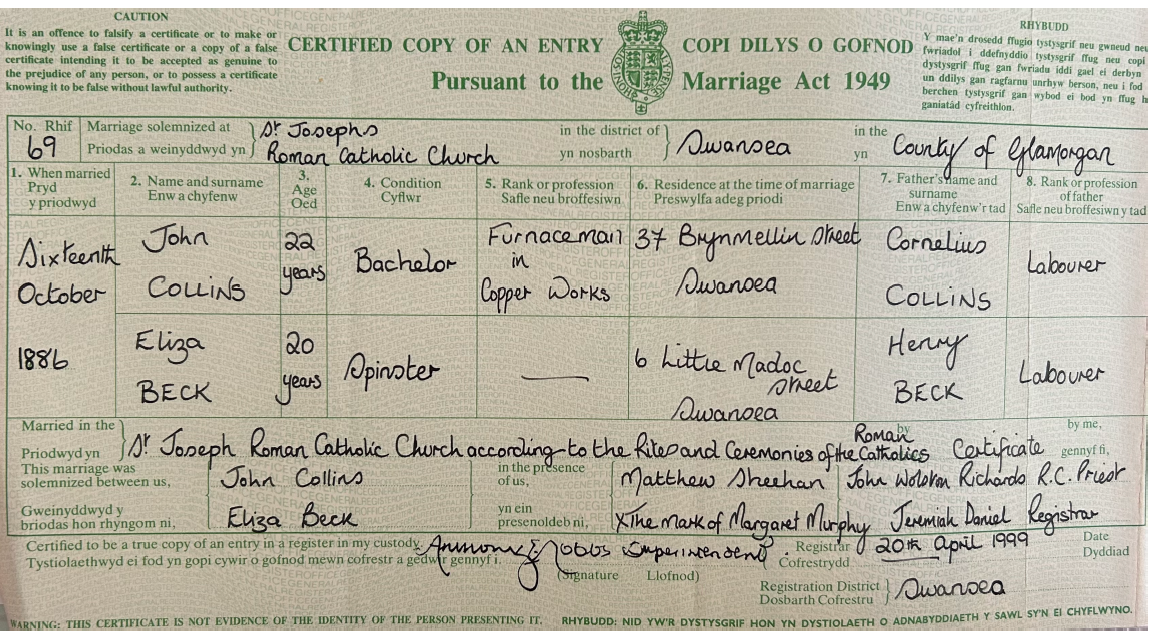
Unlike his parents, John had a steadier life, earning his pay in the copperworks of Swansea. The records show a man who climbed fast and then fell back. General labourer at 17, furnaceman by 23, foreman by 28 — an impressive rise in just over a decade, in a very dangerous workplace. By 1911 he was a copper loader; by 1921, a copper labourer again. The rise was real, and so was the fall.
John and Eliza soon settled into Llangyfelach Street, surrounded by family on the same street and nearby. They had six children.
One of their children, Thomas, sadly died in 1916 at the age of 23 of tuberculosis and bronchitis. At that time tuberculosis was prevalent in Victorian England and Wales among paupers and the working classes. It was known as the "robber of youth" due to the vast numbers of young men who succumbed to the disease. It seems from the census in 1911 he had been working as a labourer in the Hafod Copperworks but by the time of his death he was a Billiards Marker working in a hotel. Presumably not strong enough any longer for the physical requirements of the copper works. Eliza was with him when he died. This loss must have been devastating.
Another son, Cornelius, is reported in the newspapers as having been wounded in 1915 in Gallipoli serving for the Royal Munster Fusiliers.
Actually, according to his military records he was in the Lancashire Fusiliers from 1914 and saw service in Gallipoli and France. He worked up to a Sergeant. He was wounded twice; shrapnel to scalp, a gunshot wound to his neck. He got married while he was still serving. He went off AWOL quite a bit and lost pay! He was awarded the Victory Medal, the 1914-15 Star and the British War Medal.

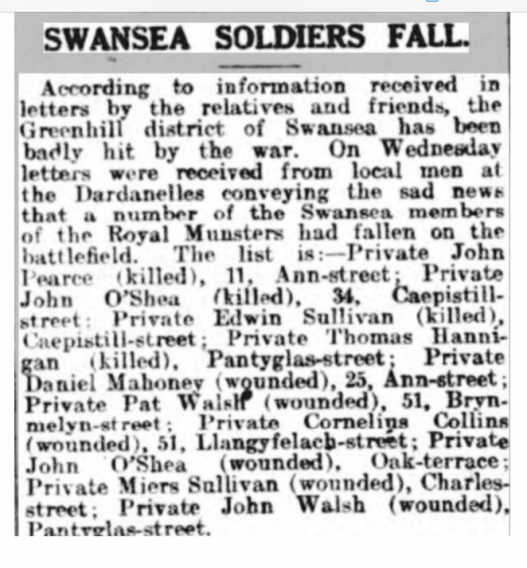
Newspaper records reveal a lighter side too. Whether he kept birds for a hobby or acquired an aviary he was certainly selling one in the paper for £3 10s in 1925!
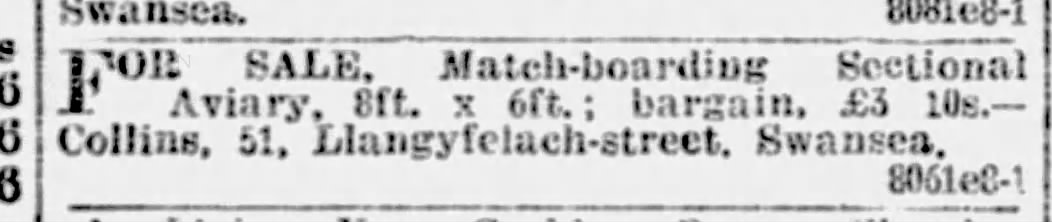
John spent virtually his whole adult life in Llangyfelach Street close to his parents, his siblings and later his children. Coincidentally, I unwittingly lived a mere 8 minutes' walk from there when I moved out of my family home for the first time at 17. Most of those houses no longer exist today, either cleared with the slum clearances or knocked down to make flats.
John lived through a period of immense change. It's amazing to think that the same man who started as a 17-year-old labourer in the 1880s was still classified as a "Copper Repairer" in the 1939 Register at the start of the Second World War. He saw the entire rise and fall of the industry from his front door on Llangyfelach Street.
It feels like he stood still while he lived through two world wars, including the relentless blitz in Swansea in the very area he lived in in 1941 during the Second World War. He would have seen the improvements in sanitation and housing with slums being cleared and better drainage and home sanitation much more common, even flushing toilets! The changes from gas and candle light to electric, from telegraph to radio. He lived through them all.
John passed away in 1945 at the grand old age of 81 with his family around him. Eliza followed him 7 years later at the age of 84.
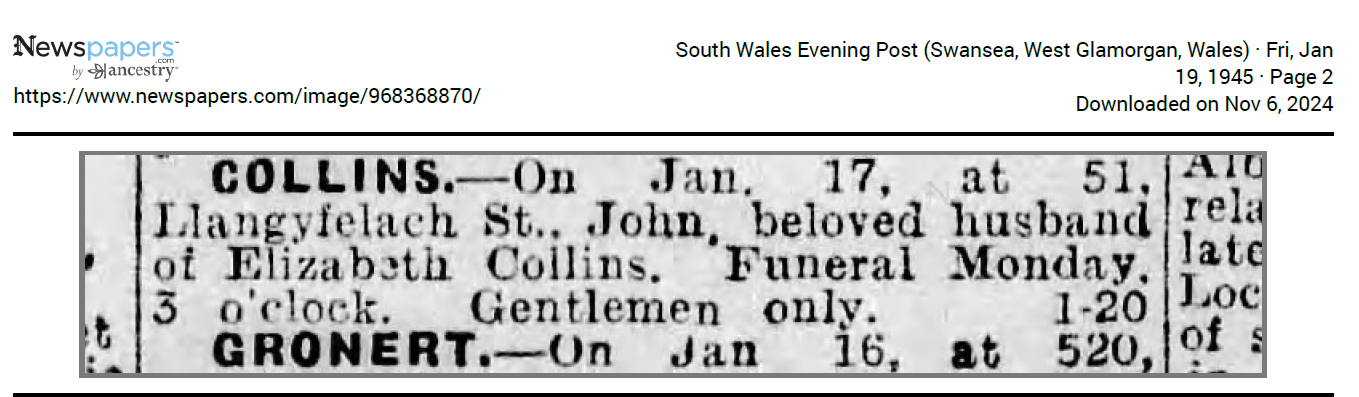
Jack Collins – A merging of the Collins and Doyles
My grandfather was born on 16 July 1890 in that same Llangyfelach Street as the two generations before him had lived. He was born and died on that street.
Like his father and grandfather before him he worked in heavy industrial factories producing metal products. Unlike his father before him, he started working in the Tinplate Works rather than the Copper Works. By 1911 he was a tinplate wheeler. The job was arduous, requiring good physical strength, constantly moving iron bars and steel around the factory for the furnace men.
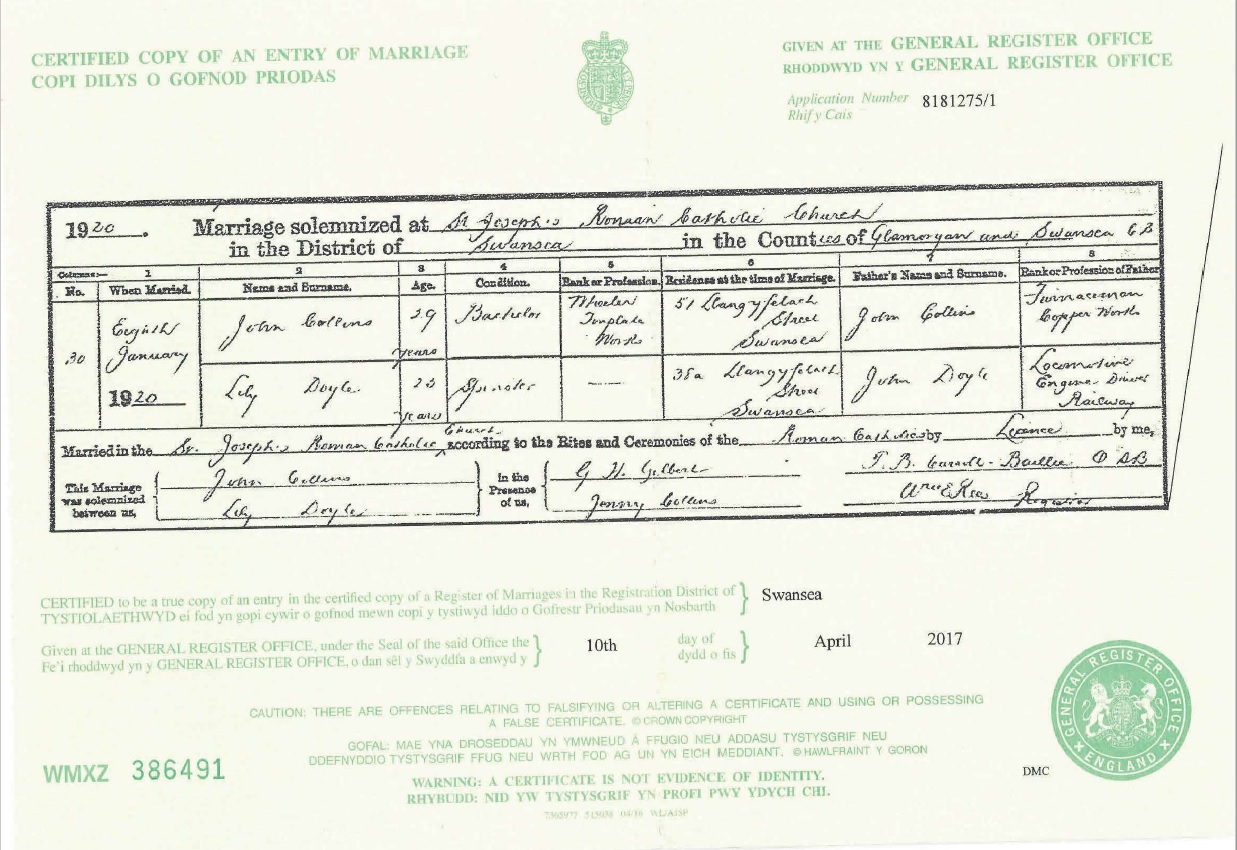
Jack married Lily Doyle in 1920. She had come over from Wexford sometime before to get away from family dramas due to her father's remarriage. She already had connections in Swansea. Jack lived a few doors away on Llangyfelach Street and love blossomed. Their firstborn came quickly afterwards followed quickly by another six children.
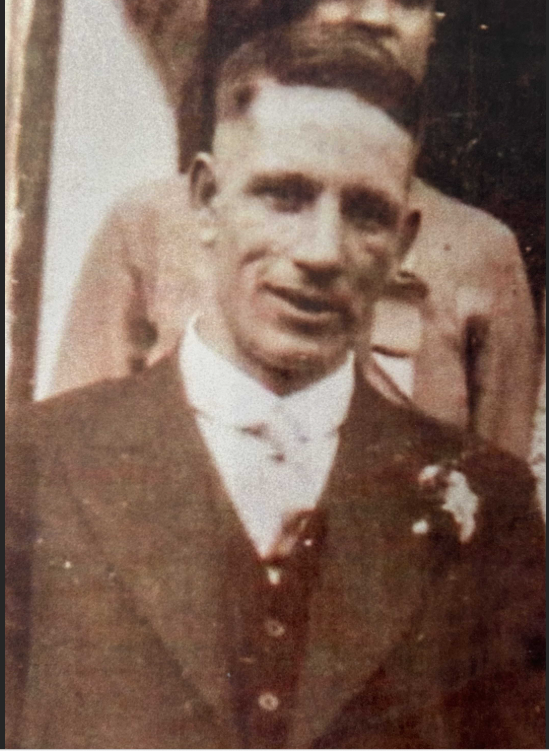
Heartbreak must have weighed heavily on them when their thirdborn, Anastasia, died in infancy. Their last two children were my father Raymond and his sister Maureen. I remember they were very close. I have a brother Raymond and a sister Maureen!
In the 1921 census he is recorded as being employed by Richard Thomas and Co although being out of work on the day of the census. This record provides a detailed snapshot of a man caught in the middle of a massive industrial depression that gripped South Wales immediately following World War I. We don't know how long his out of work status lasted but with one child under 16, his "out of work" status would have been a significant source of stress. During this time, there was no modern welfare state, and unemployed workers relied on "the dole" (unemployment insurance) or local charity. Hopefully he was not out of work for too long. At that point the family were living in Ann Street. The 1939 census has him back at work in the same job, likely with the same company. And still living in Ann Street.
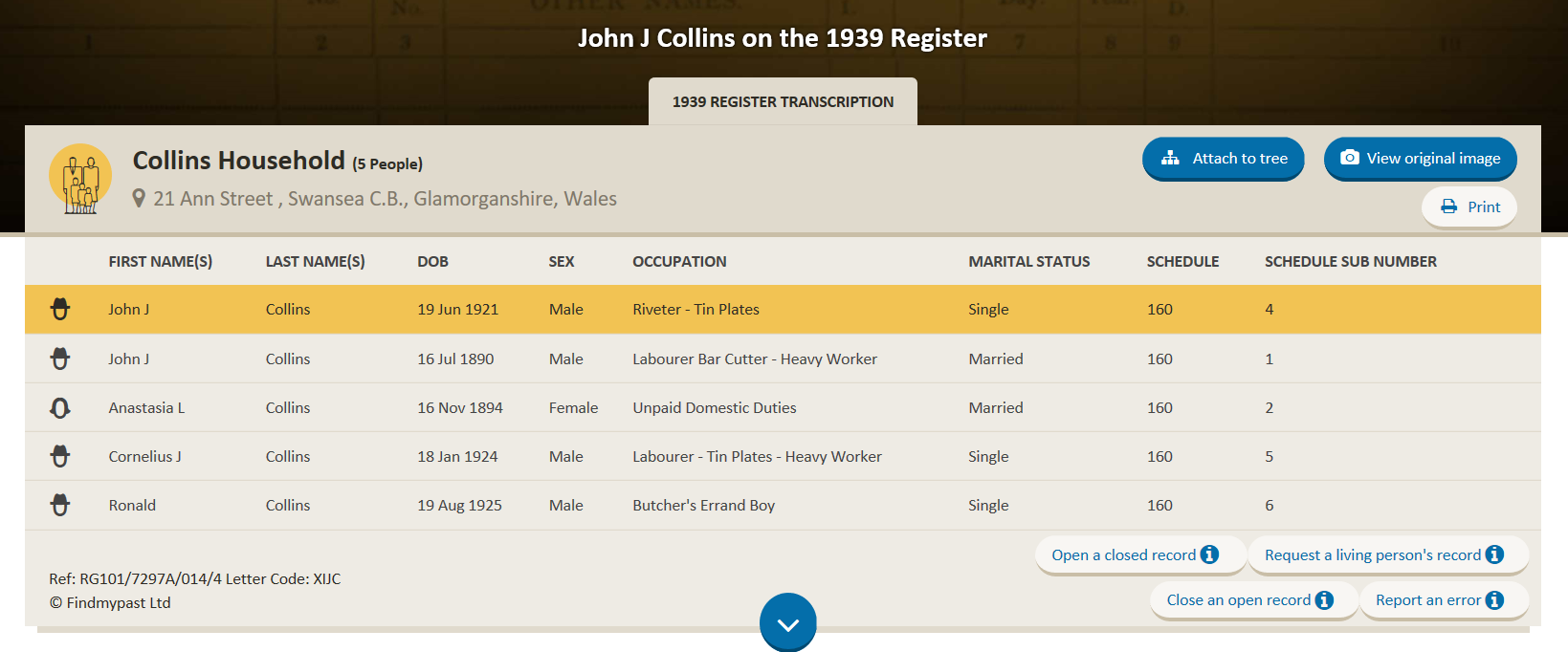
The war played heavily on the life of Jack Collins and his wife. Ann Street was destroyed just two years after the census in the three-day blitz of 1941. The 1945 electoral roll sees them back in Llangyfelach Street. Whether their house on Ann Street was destroyed completely following the blitz, we won't know. It no longer exists. It would have been a terrifying time. My mother described her own experiences as a young child living through it to me.
Jack had lost his brother in the First World War and now remarkably, three of their sons were on active duty during the war. So not only did they have to contend with the blitz and losing their housing, they had the worry of wondering if any or all of their sons would return safely. All were serving simultaneously. Ronald, who I knew as Uncle Ronnie, served in the Royal Navy, Jack serving in the RAF in India and my Uncle Connie with the Welch Regiment with the BLA. On 28 October 1944 both the South Wales Evening Post and the Herald of Wales reported that Connie had been missing in action since 18 September. Good news! In 1945 Jack and Lillian and other family members had put an advert in the Evening Post wishing him happy 21st birthday!
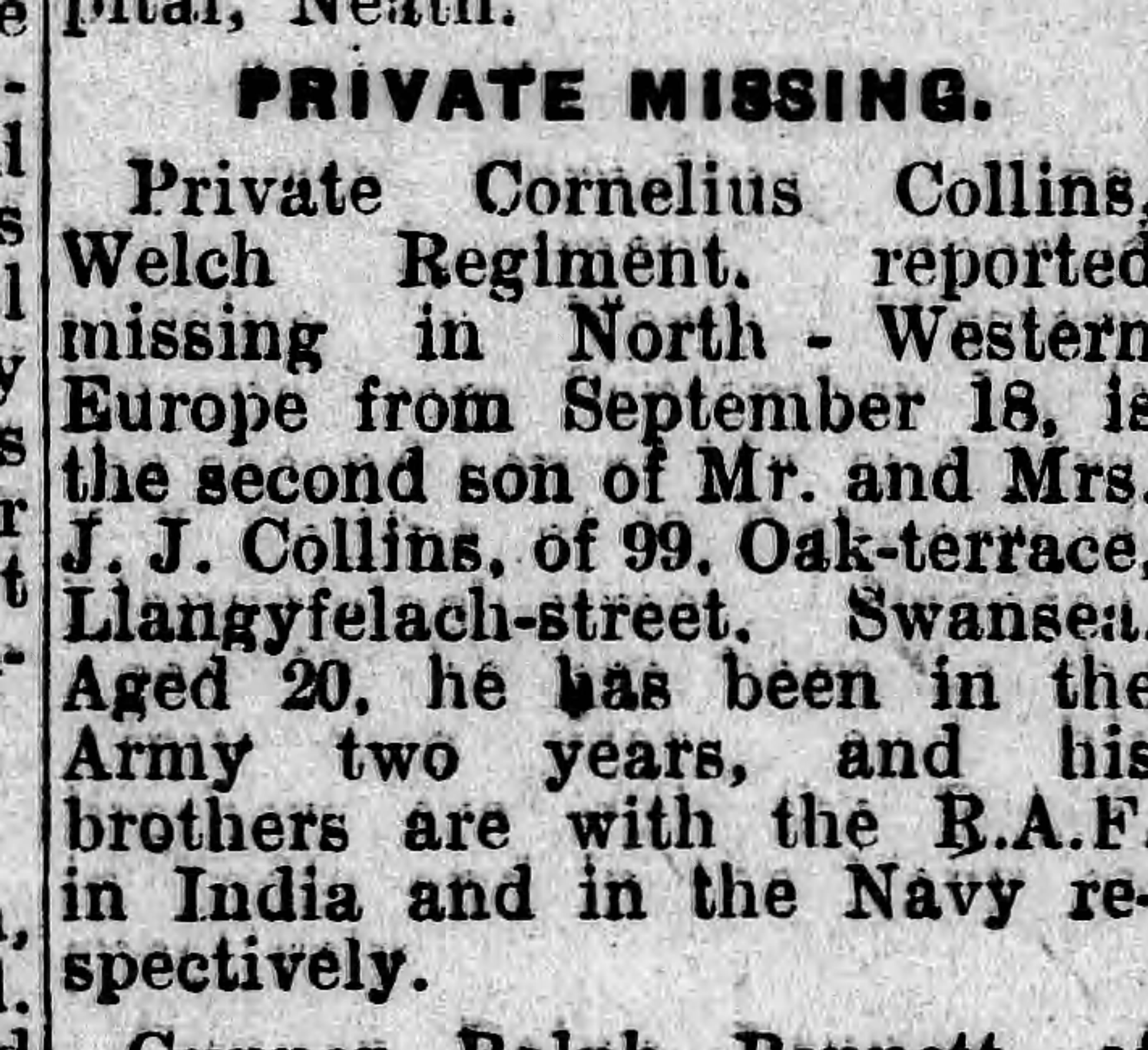
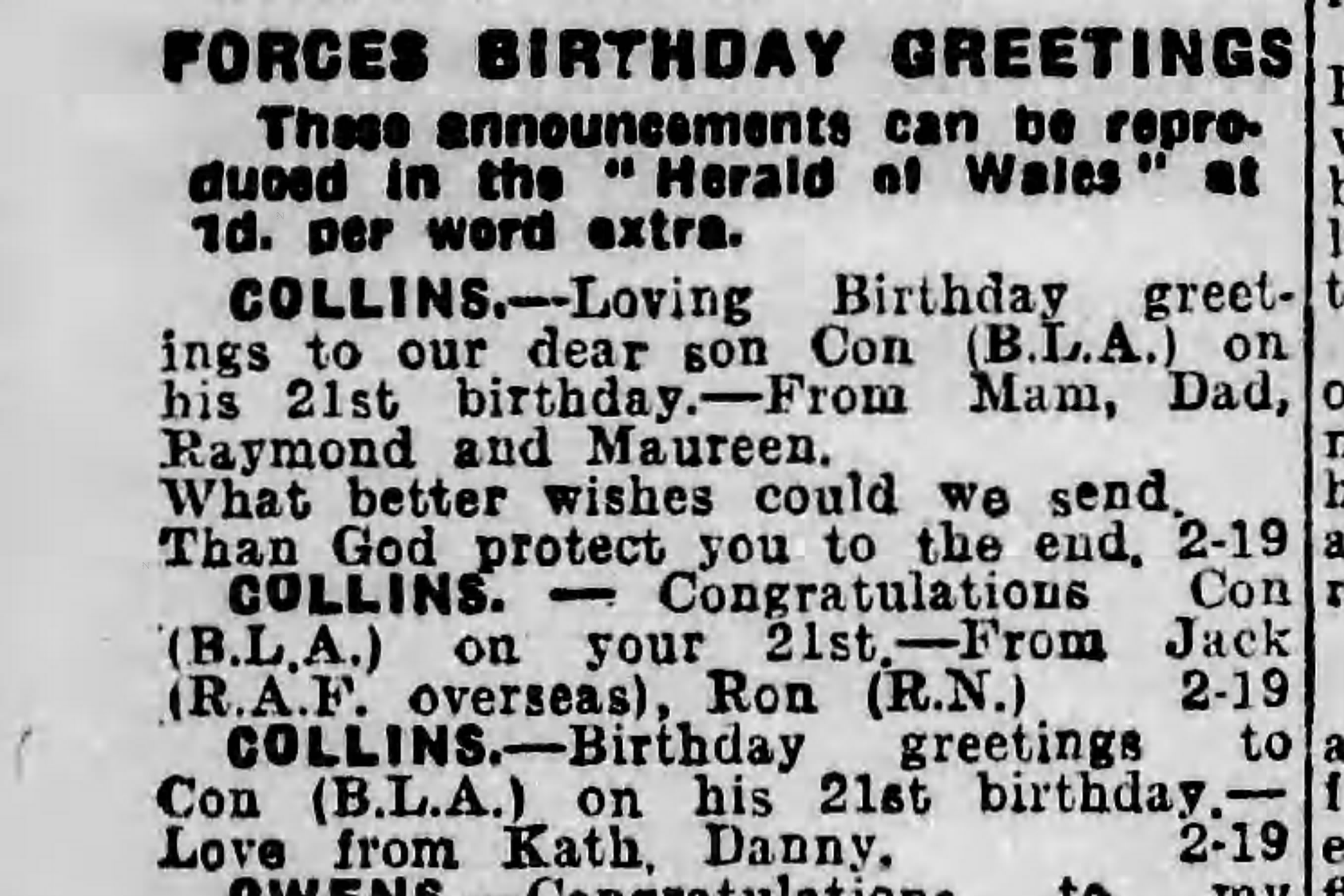
Jack stayed rooted to Llangyfelach Street with his wife and family for the rest of his days. He passed away in 1959, a year after his beloved Lillian passed away of cancer, like her mother before her. Jack didn't live the long life his father and grandfather had. Maybe the toll of loss was too much.