I knew my maternal grandparents, Thomas George and Sybil Valerie Guard, although I didn't have a particularly close relationship with them. They lived in what seemed to me as a child a big posh house in Brynmill, a world away from where we lived on the poor side of town. I have memories of the feelings of unfamiliarity and unwelcome during the sporadic visits to them sitting in their parlour as a child having tea from bone china cups and saucers. I particularly didn't know my grandfather well at all.
But he came, like all those who descended from the four family lines, from stock who escaped a hard life and hoped for better in the expanding Copperopolis in South Wales.
George Guard — Devon, 1827
The journey of the Guards from Devon to Swansea started with my great great grandfather, George Guard. Discovering him has been a bit of a journey for me. Piecing together the bits of the puzzle has at times felt like a full time job. But for now this is as much as I can evidence I know.
George was born around 1827–29 in the small parish of Huntshaw in north Devon.
Information from several censuses indicate that from the age of twelve, George was living away from his family, working as a farm servant with other households. Maybe family hardship, maybe orphaned early. It's hard to find out.
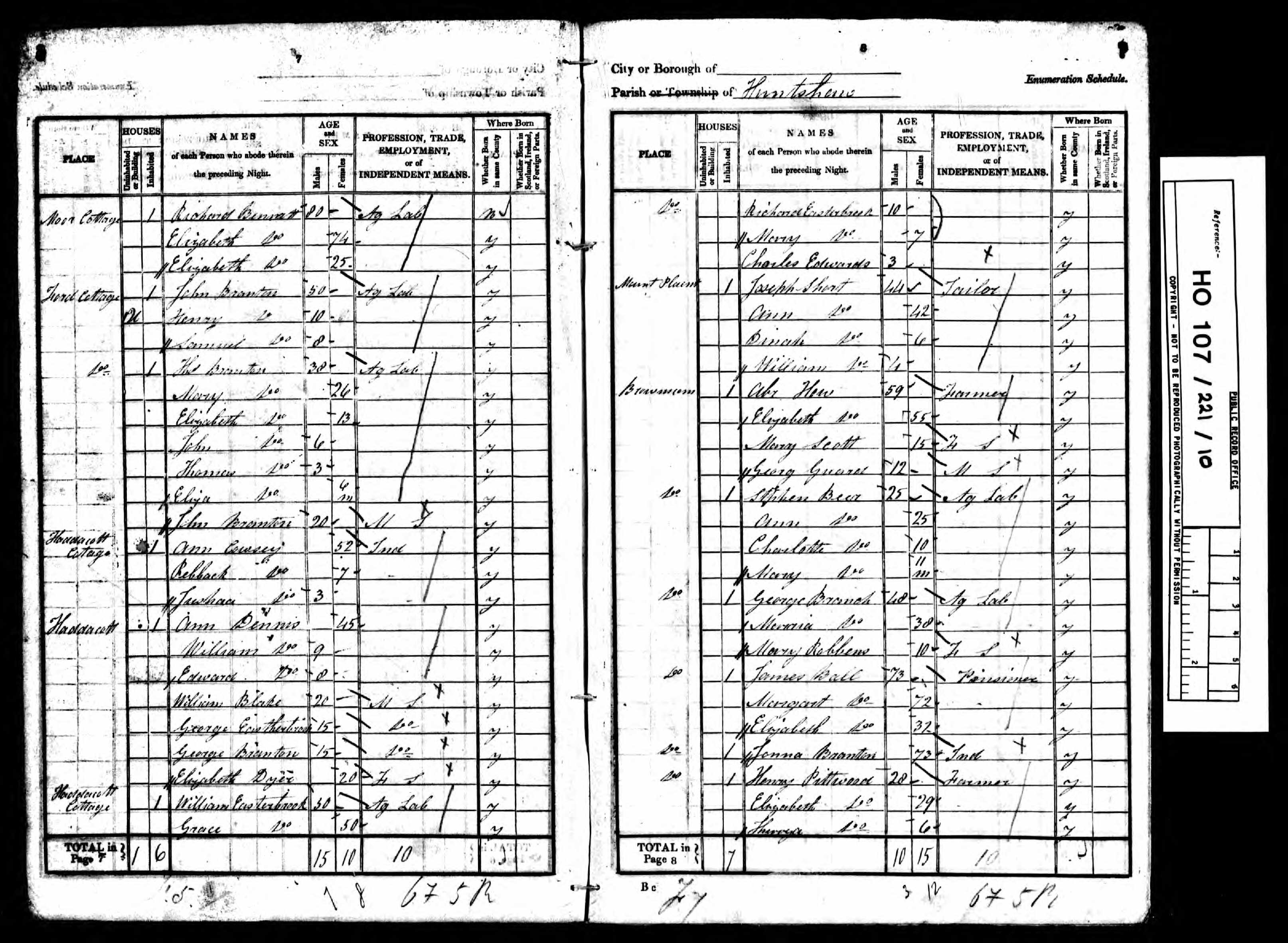
He was living and working with the Hows or Haws at just twelve with another younger female servant in 1841. It would have been a tough life going round the Mop Fairs in Devon looking for work. In that era, Annual Mop Fairs were held where labourers, servants and apprentices were hired and contracted for a year. People like George went where the work was. By 1851 he had moved to the South Molton area, working as a servant at Bishops Nympton with the Webbers. These were farmers who had many apprentices and servants over the years. And the farm next door was also inhabited by a family of Webbers.
It was here that he met Mary Ann Palmer from Exeter, and they married in South Molton in June 1855. Here is where the evidence got confusing. Mary describes herself on later censuses as being born in Exeter, which is probably the most reliable evidence. But interestingly the only Mary Ann Palmer born in Devon in the right time frame is a Mary Ann Palmer born to a Richard and Elizabeth Webber around the same time in Devonport. Could this have been from the same Webbers George served in 1851?
Their first son William was born in the South Molton area around 1856–57.
By 1860–61 George and his family made the decision to relocate to Swansea, a town he could literally have seen from the north Devon coast. He arrived with Mary Ann and young William, initially working as an agricultural labourer at Town Hill Farm on the edge of town.
Their son Thomas, my great grandfather, was born in Swansea within months of arrival. George soon transitioned to dock labouring as Swansea's copper and coal industries expanded rapidly, and the family settled on Vincent Street where they would remain for the rest of his life. George and Mary Ann raised seven children there.
There was another Guard family — a William Guard, also from north Devon — living on Vincent Street for many years, suggesting George was part of a small Devon community that had made the same crossing, possibly following each other across for work.
George Guard died on 19 February 1900 at 30 Vincent Street, aged around 67, and was buried at St Peter's Church, Swansea.
Thomas Guard — Earl Street, Hafod
After the more enforced itinerant way of life of his father, my great grandfather, Thomas Guard, seemed to crave a far more settled lifestyle. From the family home on Vincent Street, he married Mary Hannah Marshall and the 1901 census shows them at 34 Earl Street, where he would remain until his death in 1949. Nearly half a century on the same street. In the early 1900s, Hafod was a bustling industrial area, largely built to house workers for the nearby Hafod Copperworks, centred around church life.
He was a dock labourer employed by the Swansea Harbour Trust — hard, physical work — but Thomas seemed to reach beyond the docks in a way his father hadn't. By his fifties he was rarely out of the local newspapers, and not always for reasons he might have chosen.
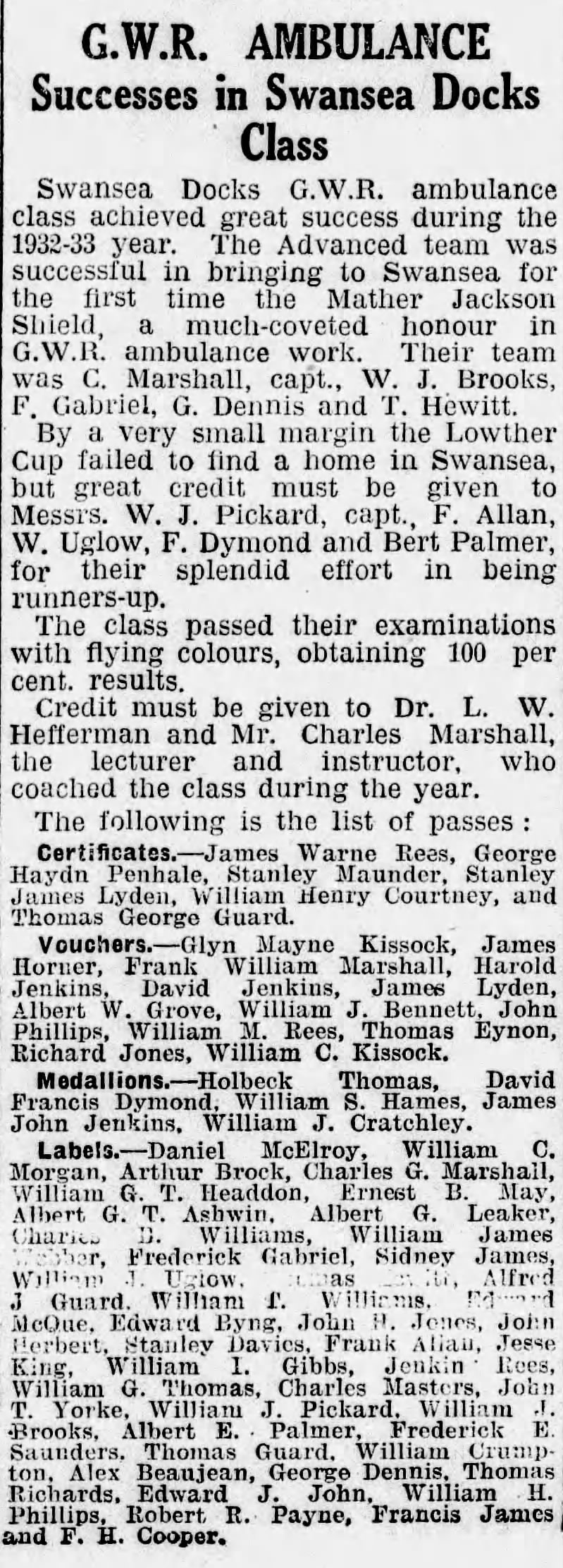
He chaired community concerts at the local Ragged School, where the hall was regularly packed and attendances were, as one reporter noted, "growing in the most encouraging fashion". He was a senior figure at Mount Zion Baptist Church and chaired the local abstinence society — perhaps not coincidentally, given that a relative living on the same street had been reported drunk and in crisis.
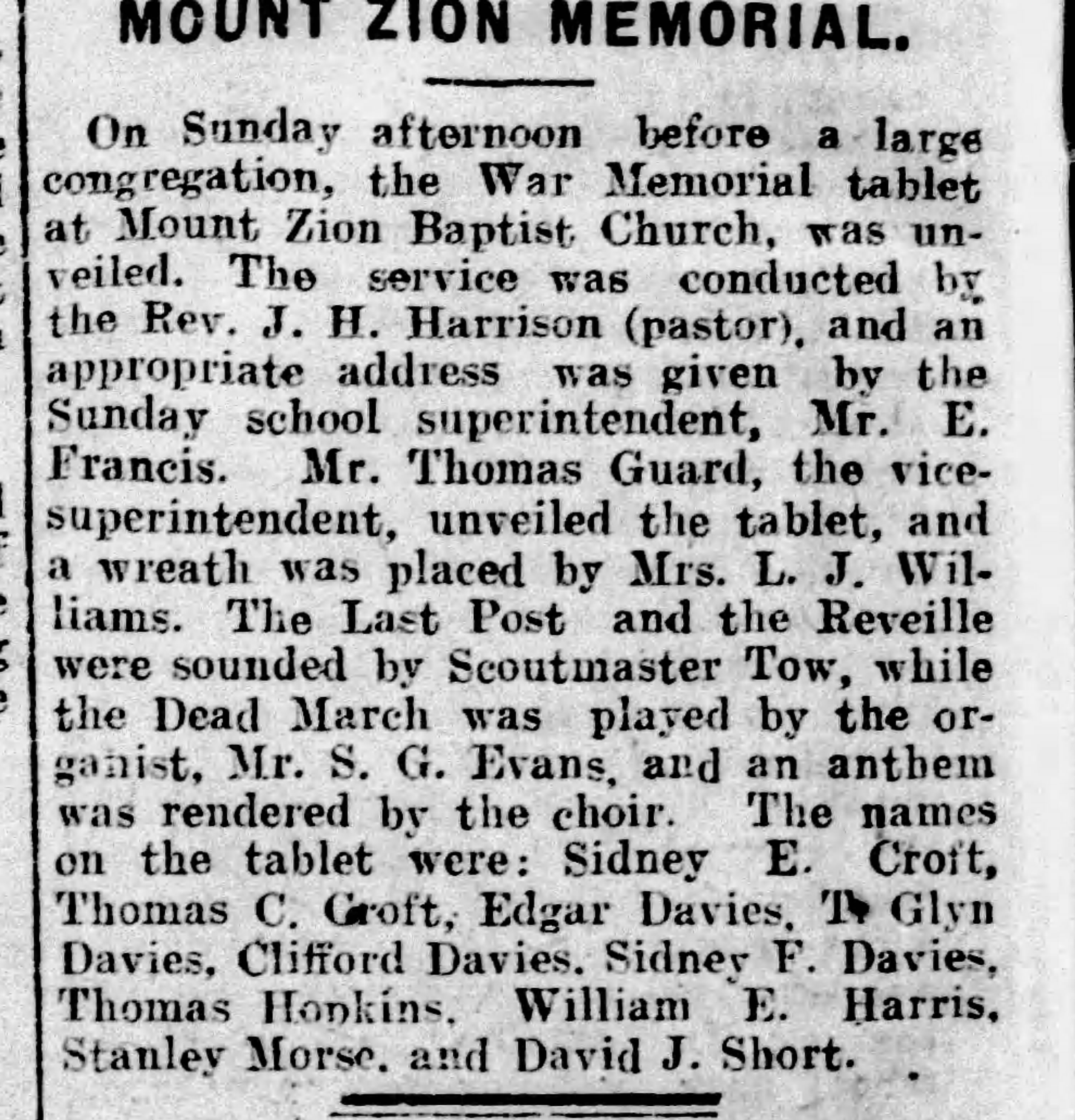
In 1905 a London organ company ran a national competition to identify the twelve most valuable hymns being sung in Britain. Thomas entered against 114 others and won — taking home a 42-guinea piano, a prize worth several months of a docker's wages.
Ten of his twelve chosen hymns came from the repertoire of the American evangelical missionaries Torrey and Alexander, whose revival campaigns had swept Britain at the time. It was not a lucky dip. It was the entry of a man who knew his hymns.
In 1913 he took his employers to Swansea County Court under the Workmen's Compensation Act. He had sprained his shoulder stepping over a plank while carrying boxes of tinplate, and had been treated for three weeks. The court found against him, accepting the employer's doctor's view that it was muscular rheumatism rather than a workplace injury. He lost, and was ordered to pay costs. A harsh outcome for a man who had simply tried to seek what was fair.
Then in 1917, at the height of the First World War, he found himself at the centre of a very grim incident. A neighbour, James Bray — an accountant lodging just doors away on Earl Street — was found dead. Thomas had discovered the landlady "collapsed in a faint", went upstairs alone, and found Bray hanging from the bedpost. He cut him down, but it was too late. The inquest returned a verdict of death during temporary insanity. The landlady's husband was reported missing at the front.
Thomas died in 1949 leaving an estate of £1,412 13s. 11d — a very large amount of money for a docker in Swansea, the equivalent of three years' full time gross wages. He was clearly a saver and left a legacy that would have provided a substantial leg up for his children.
There was always an old piano in my grandfather's house. I wonder if it was the prize piano.
Thomas George Guard — Hafod to Brynmill
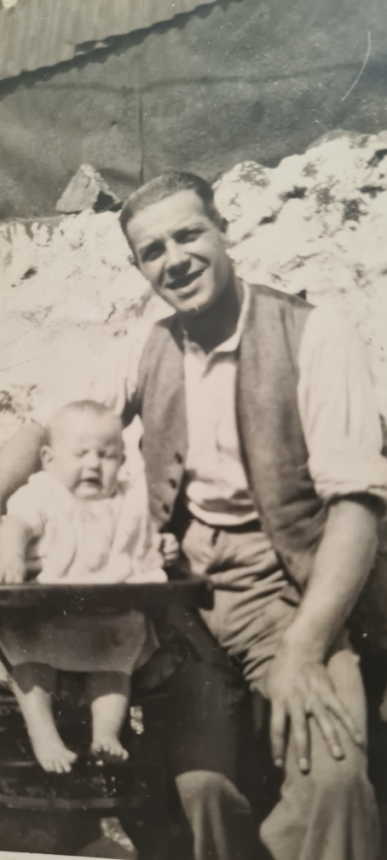
Thomas's son, Thomas George, continued this legacy, solidifying the Guard family's identity in Swansea. Thomas George moved from the family home in Earl Street in 1932 when he married my grandmother Sybil Valerie Miners. I don't know how they met. They were of different religions but in similar working class communities, the Guards in Hafod and the Miners in Manselton. My grandmother joined my grandfather in Hafod in Aberdyberthi Street where they lived for seven years. My mother and my uncle were born during this time. My mother told my son about her experiences during the war for a school project he did at primary school.
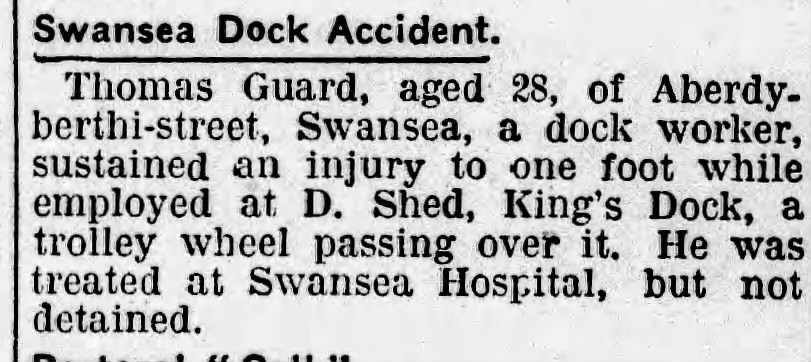
At some point during the war years the family moved to Malvern Terrace in Brynmill where my grandparents lived till they died.
So an interesting discovery during my genealogy journey… A distant cousin, Sam, contacted me to see if I knew anything of John Marshall and how he ended up in Wales. I had a Marshall on my family tree and he was sure it was connected. Mary Hannah Marshall's father was George Marshall, born in Milford Haven in 1855. His father was John Marshall, and this is where the family story takes an unexpected turn.
John Marshall first appears in the 1841 census as a teenage servant in Haverfordwest, already recorded as foreign born. By 1851 he is married and settled in Milford Haven with his wife Mary Reynolds, daughter of a local sailor, his birthplace recorded as the South Sea Islands. By 1871 he describes himself as from New Zealand, and is by then a pensioner of the Revenue Service with a large family on Charles Street, Milford Haven.
On his own marriage certificate, the space where his father's name should be is blank. Just nothing there.
How John Marshall came to be a teenage servant in Pembrokeshire in 1841 is unknown. Milford Haven was a significant whaling port with regular Pacific traffic, and young men came back on those ships under all kinds of circumstances. What is slightly surprising is that one of the witnesses at his marriage was Augusta Sophia Richards, wife of a solicitor's clerk in Haverfordwest — a woman of some social standing. She and John were roughly the same age and had likely known each other since his earliest days in the town. Getting into the Revenue Service in those days required someone to vouch for you. It is possible that connection mattered.
Whatever brought him to Pembrokeshire, he settled, married a local woman, raised six children, and served long enough in the Revenue Service to draw a pension. He lived out his days on Charles Street, Milford Haven, a long way from wherever he started.
Which means that Mary Hannah Marshall, who married Thomas Guard and settled on Earl Street Swansea, carried a Pacific bloodline into the Guard family. And ultimately to me.
Image credits
Morfa Copper Works © vectorkraft, CC BY-SA 2.0, via Wikimedia Commons
All newspaper clippings and family photographs are from the author's personal collection.