Copperopolis! Swansea! Abertawe!
This was the place I was born, brought up in and lived until, like my ancestors before me, I travelled elsewhere, in the hope of a better life. It never leaves you wherever you are.
Swansea was also the place where the Collins, Doyle, Guard and Miners lineages converged to bring centuries of DNA together into me.
Swansea evolved as a small coastal town in the 12th century around Swansea Castle, built by the first Norman lord of Gower, Henry de Beaumont. It was a small town surrounded by large swathes of farmland.
Over the centuries, Swansea and South Wales became the world's first industrial powerhouse — the force that pulled my ancestors there from Cork, Wexford, Cornwall and Devon.
Copper was fundamental to the Industrial Revolution in the UK and internationally and was the catalyst that transformed Swansea from a small port town into an international industrial centre.
The natural advantages of Swansea's geography — its accessible, large natural harbour, abundant coal deposits from nearby valleys, and established sea and land trade routes — made Swansea an ideal smelting location for the developing copper industry.
Swansea's rapid rise to "Copperopolis" began in the 1700s, when it became a global hub for copper smelting. 60 to 70% of the world's copper was produced by Swansea at its peak.
Ships brought ore in from Cornwall, then from Chile, Cuba, Australia and beyond, and carried finished copper out to every corner of the British Empire.
For a time, Swansea sat at the centre of a global copper network — a small Welsh town with a reach that stretched halfway around the world. By 1860, all but one of the UK's copper smelting factories were in Swansea.
And copper changed the landscape of Swansea forever. Docks were dug and extended to handle the ore coming in and the metal going out. Railways were laid to carry coal down from the valleys and finished goods to the English Midlands. Tinplate works, steelworks and engineering shops grew up alongside the copperworks, so that by the late 1800s, Swansea wasn't just a copper town — it was an industrial hub with work for almost anyone willing to come.
Copperopolis needed labour. Swansea saw a massive influx of people required to service the fast-moving industrialisation. In 1700, Swansea's population was around 2,000, but by 1900 it had increased to around 100,000. Workers migrated primarily from across rural Wales, Ireland, Cornwall and Devon, and beyond.
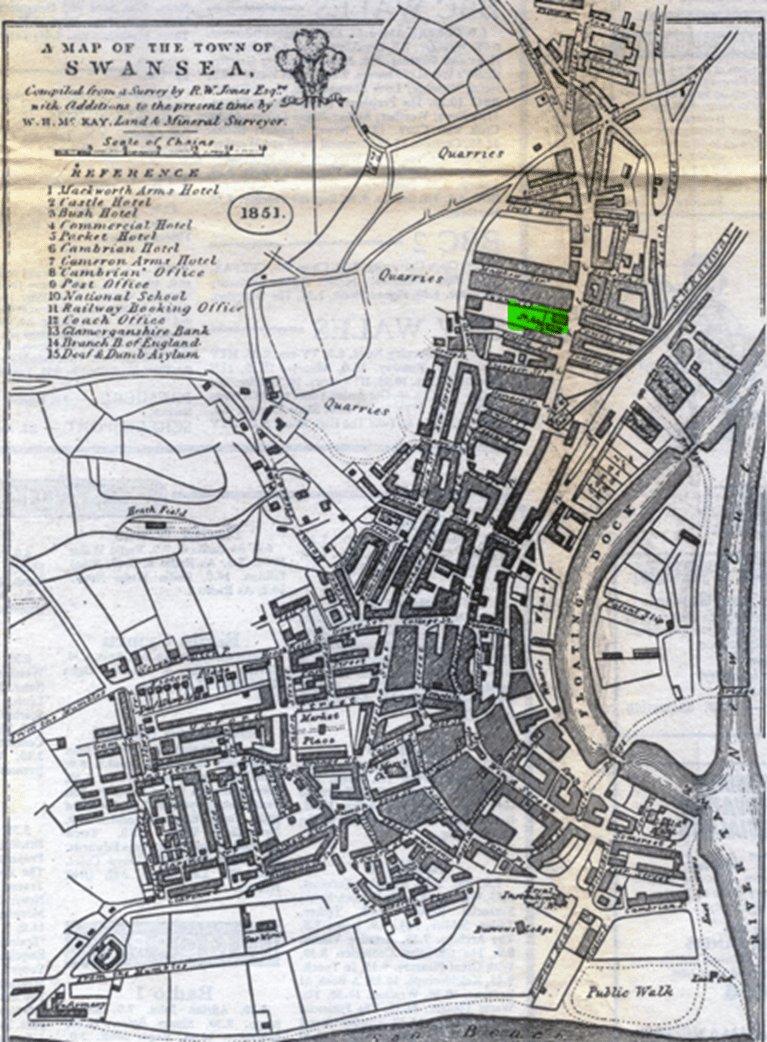
Map of the Town of Swansea, 1851. Surveyed by R.W. Jones, Land & Mineral Surveyor. Greenhill area highlighted.
People like George Guard, Cornelius Collins, Bernard Miners and Lily Doyle moved not just for the work, but for the hope of a better life — with Swansea offering a bustling hub of industry that promised economic growth and the prospect of new beginnings.
The massive copperworks like Hafod, Morfa, White Rock and Landore lined the banks of the River Tawe, their furnaces lighting the Lower Tawe Valley day and night.
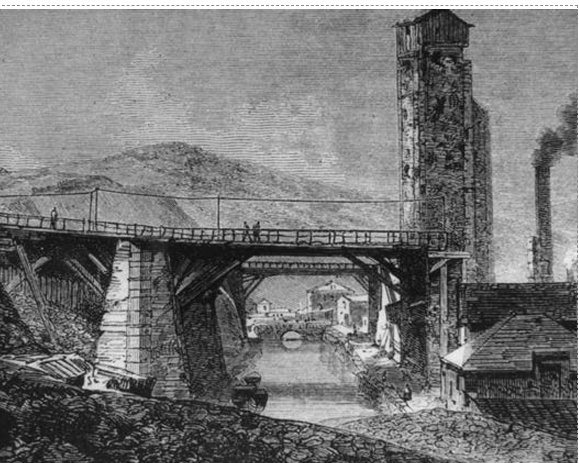
The Hafod Works, 1860s · © Crown Copyright: RCAHMW. Licensed under the Non-Commercial Government Licence v2.0
The need for more labour than was readily available changed the face of what were rural villages into industrial villages. With industry concentrated in the Lower Swansea Valley, the rural lands that were built on became known as Landore, Hafod, Morfa, Plasmarl, Clase, Morriston and Manselton. From rural farmland with scattered cottages these became the densely populated areas we know today.
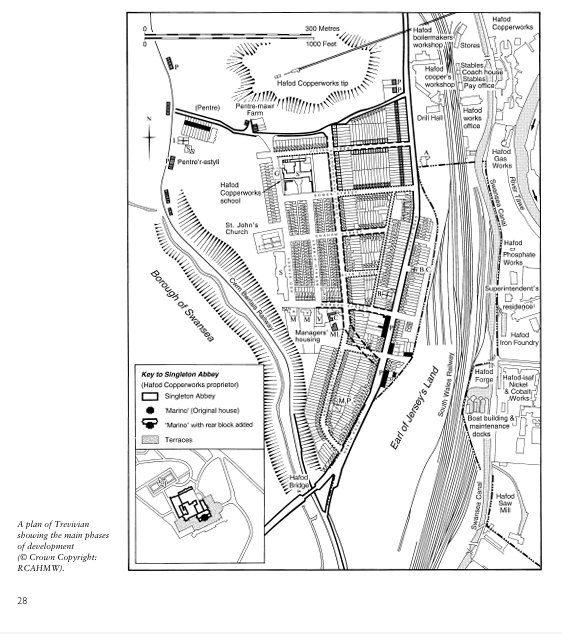
A plan of Trevivian showing the Hafod Copperworks and workers' terraces · © Crown Copyright: RCAHMW. Licensed under the Non-Commercial Government Licence v2.0
This east side of Swansea, polluted by the prevailing westerly winds carrying toxic sulphur and metal eastwards, became that of the working classes, while the west side, largely unaffected by the pollution, became Swansea's middle-class suburbs.
While there was steady work, life was harsh in these areas with chronic crowded housing, extreme pollution from the factories and disease outbreaks.
My ancestors settled in and around these expanding working-class conurbations servicing the new industries.
Morriston, which had previously been rural land — where some of my family still live — was designed by Sir John Morris in the 1700s to expand his copper wealth as the first industrial village specifically built for workers to live in.
The nearby areas of Plasmarl and Clase is where George Guard, my 2nd great grandfather, settled after first arriving to farm in Town Hill before being lured by the steady work of the docks.
And Manselton, where the Miners settled in the 1850s: who would have thought this was a site of abstinence in the 1800s! The local temperance movement — of which my 2nd great grandfather, Thomas Guard, was a leading light — declared Manselton alcohol free in its leases and titles to counteract the horseracing nights at Cwmbwrla.
These nights drew in huge crowds of up to 60,000, including a large contingent of Irish with their hard drinking and gambling ways.
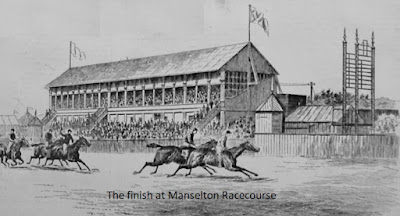
The finish at Manselton Racecourse · Courtesy of the Illustrated Sporting & Dramatic News, c.1887
Who knows — maybe even my 2nd great grandfather, Cornelius Collins, who lived just down the road, always drinking and fighting, was there.
Anyway, a local pub — the Manselton Hotel, where the jockeys and horse owners stayed — was moved by the owner, Sir Richard Mansel, a short distance away to Brynhyfryd to avoid the temperance rules. The temperance lot were outraged and rolled their barrels of beer down the street.
The racecourse is long gone of course, but the Manselton Hotel is still there. Thinking about it, there are no pubs still in Manselton — many on the outskirts, but none within those Manselton streets. Although remembering my years there, I don't think there was much temperance going on in the houses.
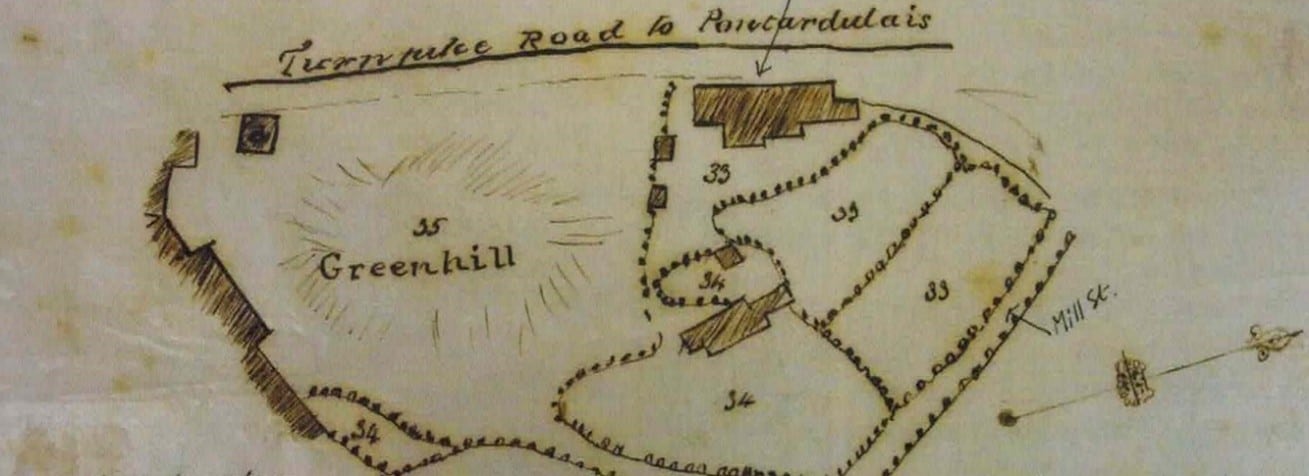
Greenhill, Swansea, 1819 — open farmland a generation before the great Irish migration
The Collins and Doyles headed straight for Greenhill — or Little Ireland, as it became known in the 1840s. Placed between the town centre, Landore and Hafod, by the time my ancestors arrived there was already a large Irish population there, many of whom were seeking respite from the Great Irish Famine. Here amongst the housing slums, poverty and cholera, they found their community, their language, their chapels.
Both the Doyles and Collins lived on or around Llangyfelach Street in Greenhill, part of a bustling, working-class neighbourhood. Llangyfelach Street would have been densely packed, with terraced houses built close together. Many residents worked long hours in nearby factories and docks, and families were often large, creating a lively and tightly knit community. Life was hard, with limited sanitation and cramped living conditions, but the shared Irish heritage fostered a strong sense of community, with neighbours looking out for each other and supporting one another in times of need.
The street itself, running through Greenhill, was central to local life. There were small shops, pubs, and market stalls along or near it where people could buy essentials. St. Joseph's Church, the Catholic church around which much of this Irish community revolved, was a short walk away. The church wasn't just a place of worship; it was a cultural anchor, offering community gatherings, support, and a sense of continuity for Irish immigrants.
Despite the economic challenges, Llangyfelach Street had a vibrant atmosphere with strong social bonds, shaped by the Irish identity of its residents and their shared experiences of migration, hard work, and resilience.
Four people, their families, four journeys, one town. And that's how I got here.